

Summary
- Waterfront: Your Lot Touches the Water, but the Lake Stays Public
- Shared Access Is Worth Exactly What the Deed Says
- Ten Years Without Use Is Enough to Extinguish a Servitude
- In the Laurentians, the Municipality Regulates Docks and Boat Launching
- The Certificate of Location and the Deed Show Which Access You’re Buying
- Compare Each Property’s Lake Access Rights Before Making an Offer
- FAQ
Key takeaways: A property’s lake access rights are found in its titles, not in the listing. A waterfront lot touches the water, and no one may cross it without a published servitude. Shared access allows only what the deed spells out. The municipality then sets the rules for docks and boat launching.
Buying a chalet on the water does not make you the owner of the lake. Lake access rights for your future property are established lot by lot: two neighbouring chalets can have access rights that have nothing in common.
The listing and the photo of the dock settle nothing. The titles, the land surveyor’s plan and the municipal bylaw are what tell you what you are buying.
Waterfront: Your Lot Touches the Water, but the Lake Stays Public
In short: A waterfront owner controls passage across their land, not the lake, whose bed often belongs to the State and on which the public may travel.
A waterfront property touches the lake, but exclusivity stops at the shore. Under article 919 of the Civil Code of Québec, the beds of navigable and floatable lakes belong to the State up to the high-water line, as do the beds of non-navigable lakes bordering land granted by the State after February 9, 1918.
Article 920 allows anyone to travel on a lake if they can gain access to it legally, provided they do not encroach on the banks or infringe on the rights of waterfront owners. The kayaker paddling past your dock is within their rights. The one who comes ashore on your beach is not.
The shoreline buffer strip and its permits are covered in the guide to buying on a lake.
A 60-Metre Strip Long Belonged to the State
In the Laurentians, many lots originate from State land grants. Under section 45 of the Act respecting the lands in the domain of the State, these sales reserved a strip of about 60 metres along non-navigable lakes for the State as of June 1, 1884, and then along all lakes starting in 1970: the so-called three-chain reserve.
Section 45.1 transferred to the lot owner, free of charge, the strip still held by the State on December 17, 1987, but not the lake bed. Some strips remained with the State (section 45.2), including those leased to another person on December 12, 1991. An old lease on the shoreline can therefore still separate a lot from the water.
Shared Access Is Worth Exactly What the Deed Says
In short: Without a published title, shared access does not exist in law, and any access that does exist allows only the uses named in the deed.
The words “lake access” in a listing can mean three things: a right-of-way servitude to the water, an access lot held by an association or co-owners, or mere permission. The first two rest on a title. The third rests on nothing.
Article 1181 of the Civil Code is unequivocal: a servitude cannot be established without a title, and possession, even from time immemorial, is not enough. The path that three generations have walked therefore creates no right.
Article 1177 attaches the servitude to a lot, the dominant land, and not to a person. A right of way granted to the seller alone may not follow the property.
Before trusting the listing, have five points confirmed:
- Your lot is named. The deed identifies the dominant land by its number.
- The route is described. The deed states where to pass and how wide the path is.
- The uses are in writing. Swimming, dock, boat launching, motor: anything the deed leaves out remains uncertain.
- Costs are shared out. Who maintains the path, the beach or the dock.
- The deed is published. It bears a registration number in the land register.
The table places these three situations below the waterfront lot, from the most secure to the most fragile.
| Situation | What you hold | What can take it away | Where to check |
| Waterfront property | A lot that touches the lake | A servitude in favour of others, a strip still held by the State | Certificate of location, titles |
| Published access servitude | A right attached to your lot over someone else’s land | Ten years of non-use, among other things | Deed of servitude, index of immovables |
| Shared access lot | A share of the land or a membership | The association’s rules | Deed of acquisition, rules |
| Permission or habit | Nothing in law | The sale of the neighbouring lot | No document |
A seller who cannot produce any deed is selling a habit, and the habit ends with them.
Ten Years Without Use Is Enough to Extinguish a Servitude
Article 1191 of the Civil Code sets out five ways a servitude can be extinguished, including non-use for ten years.
Non-use is a trap for buyers. Éducaloi reports a 2024 case on Île d’Orléans: a right of way had gone unused from 2006 to 2018. A couple who had owned the neighbouring lot since 2021 had built their house counting on that access. The Superior Court ruled that the servitude was extinguished, and an extinguished servitude does not come back.
A shared path abandoned for ten years may therefore be worth nothing, even if it appears in the title. Dated photos of people using the path are worth more than the seller’s memory.
Interested in two chalets on the same lake? Ask about access in writing: the seller’s declarations will keep a record of the answer.
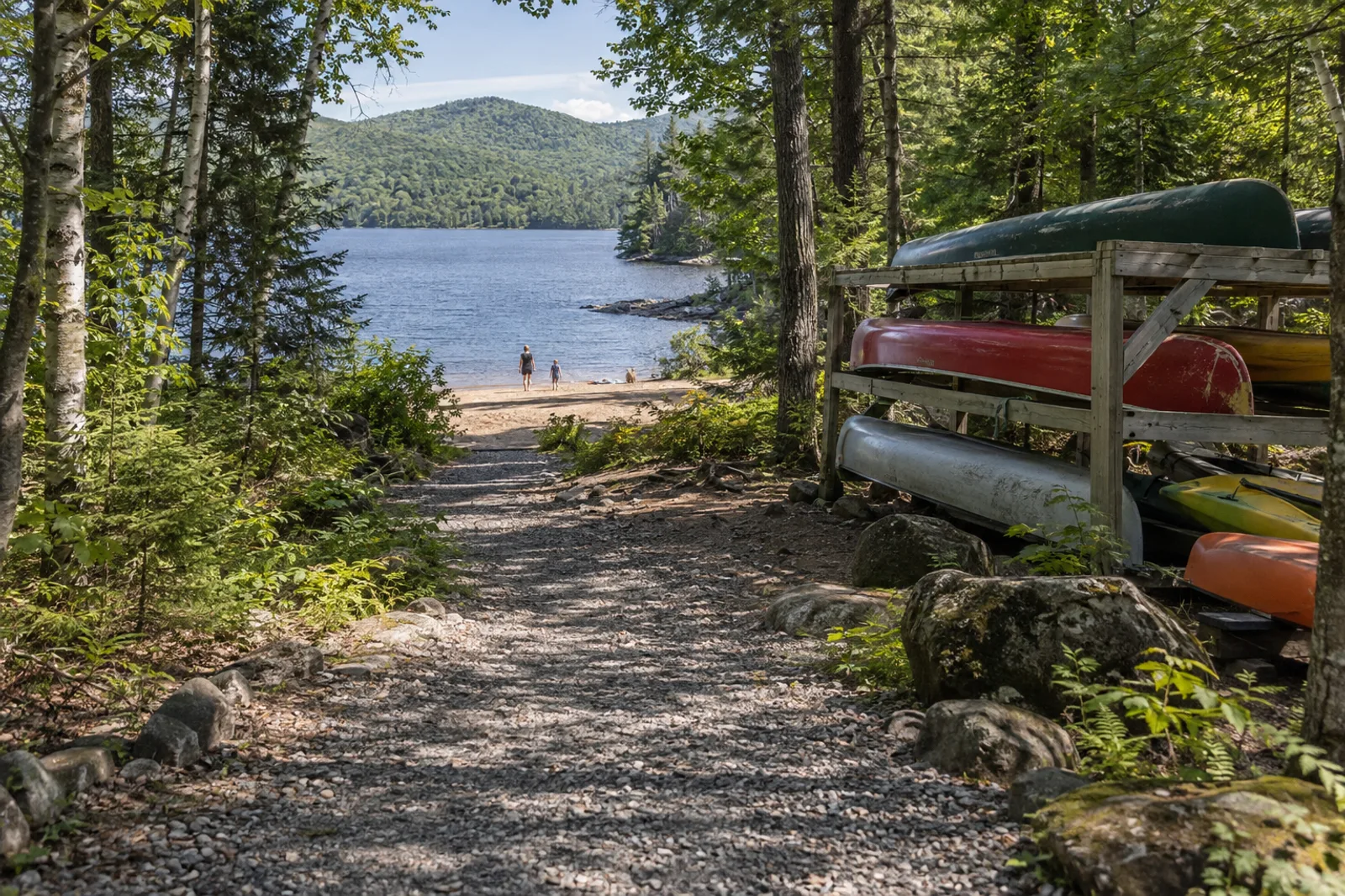
In the Laurentians, the Municipality Regulates Docks and Boat Launching
The title tells you where you can pass; the municipality tells you what you can build at the water’s edge. In Saint-Sauveur, zoning bylaw 222-2008 (in French) allows only one dock per residential lot, no larger than 20 m², at least 2 metres from the property line (section 131.2). A vacant lot used as lake access can have one, but a development’s shared lot is not entitled to one dock per family.
On Lac des Sables, Sainte-Agathe-des-Monts bylaw 2026-M-430 (in French) prohibits boat launches on waterfront lots, except for waterfront owners launching their own boats. Holders of a notarized right-of-way servitude to the lake count as waterfront owners; mere permission does not. Every motorboat must display a sticker, costing $135 to $270 per season for a resident’s first boat depending on the type, while non-residents can only get a day sticker reserved 48 hours in advance.
Public access also depends on the address. On Lac Tremblant, the only boat launch is on private land owned by Préservation Lac-Tremblant-Nord, a non-profit organization with which Mont-Tremblant has signed an agreement for its residents, limited to two boats per property. On Lac Rond in Sainte-Adèle, non-residents have no longer been able to launch watercraft since February 2026, according to Journal Accès (in French).
At Domaine des 4 Lacs in Saint-Adolphe-d’Howard, the $60 annual membership fee gives access to the private beach on Lac à la Truite and to boat launches on three lakes, according to the association’s FAQ (in French). When buying, ask whether this access comes from the title or from the membership fee alone.
The Certificate of Location and the Deed Show Which Access You’re Buying
The Regulation respecting the standard of practice relating to the certificate of location lists, in section 9, what the land surveyor must verify. On the waterfront, five paragraphs matter most:
- The updated description of the lot (3°). Its boundaries show what borders the land on the water side: the lake, another lot or a strip.
- Active and passive servitudes (7°). An active servitude gives you access. A passive one gives others access across your land.
- Apparent servitudes (9°). The neighbours’ path, with no written right, may be flagged as a charge to be regularized.
- Apparent encroachments (13°). A dock or stairway built partly on the neighbour’s land.
- The shoreline protection strip (20°). Is the lot located within it, in whole or in part?
Paragraph 7 holds the worst surprise: a waterfront lot can carry a passive servitude in favour of an entire development, and “exclusive” access turns into the neighbours walking past your porch.
The seller’s deed of acquisition completes the picture: a lot that touches the water, the access servitude and its registration number, the share of costs for the dock or beach. A certificate that no longer reflects the property, after a dock has been built for example, should be redone before signing. Plan for these reviews in the promise to purchase, with a condition that gives the notary time to examine the titles.

Compare Each Property’s Lake Access Rights Before Making an Offer
Lake access comes in three layers: the lot, the published servitude, then the rules of the municipality and the association. The first two are read with the land surveyor and the notary, the third at city hall. The worn path and the neighbour’s promise do not survive the next sale.
A real estate broker in the Laurentians can request these documents from the seller as early as the first visit.
FAQ
Which documents show a property’s lake access rights?
Three documents are enough to establish a property’s lake access rights. The certificate of location describes what borders the lot on the water side and lists active and passive servitudes. The seller’s deed of acquisition confirms the description of the lot. For shared access, the published deed of servitude, or the association’s rules, sets out the permitted uses. The notary then carries out a full examination before the sale.
Can a neighbour cross a waterfront lot to reach the lake?
No, unless a title allows it. The Civil Code provides that a servitude cannot be established without a title and that use, even over a very long time, is not enough to create one. A waterfront lot may, however, carry a published passive servitude in favour of other lots, sometimes an entire development. The land surveyor must then mention it in the certificate of location, along with the registration number of the deed in the land register.
Does a right-of-way servitude to the lake allow you to install a dock?
Not automatically. A servitude allows the uses set out in the deed, plus whatever is needed to exercise them. A right to walk to the water does not necessarily include the right to install a dock, store a canoe or launch a motorboat. Municipal zoning also limits the number and size of docks. Have each use spelled out in writing in the deed before signing.