

Summary
- Two checks the building inspection does not cover
- Flow is measured at peak hours
- Clear water can still be contaminated
- Casing and distances, two measurements to take during the visit
- Three dates pinpoint the age of a septic system
- One more bedroom than the plan, and the tank becomes too small
- The documents to ask the seller for
- What the tests cost, and how long they take
- Having the artesian well and septic tank inspected during the conditions period
- FAQ
Key takeaways: Before buying an off-grid cottage, the artesian well needs two tests: a flow test and a water analysis by an accredited laboratory. The septic system is judged by its age, its permit, its pump-outs and, if needed, an inspection by a professional. These tests go into the promise to purchase as conditions.
“How much does the well produce?” The seller answers five gallons a minute, and the visit moves on. For an artesian well, the useful answer actually comes down to three questions: which gallons, measured when, and for how long?
The septic tank, for its part, stays out of sight: its age is read in a permit, its condition in a test.
Two checks the building inspection does not cover
The pre-purchase building inspection examines the structure, the roof and the mechanical systems, not the well or the leaching field.
The OACIQ requires the buyer’s broker to recommend a microbiological water test and a septic system inspection clause as soon as the promise to purchase is drawn up.
Flow is measured at peak hours
In short: The well must keep up during the hours of highest demand, and the drilling report records the flow rate, the date and the length of the test.
The Water Withdrawal and Protection Regulation requires the well driller to assess whether the well will be sufficient during the hours of highest demand, and to notify the owner if it is not (section 23). Eight guests, two showers and the dishwasher on a Saturday in July: that is the moment that counts.
According to the Ministère de l’Environnement’s technical guide on water withdrawal (in French), the drilling report records the date and length of the flow test, the static level, the flow rate obtained and the pumping method. The municipality receives a copy within 30 days: if the seller has misplaced theirs, ask the town planning department for it.
The seller’s five gallons
The same guide notes that well drillers often express flow in US gallons (3.79 litres) or imperial gallons (4.55 litres). Five gallons a minute therefore means 19 or 23 litres depending on the unit, a 20% difference. Ask which unit is meant.
And that flow rate dates from the drilling. For today’s flow, a water quantity test is added as a condition of the promise to purchase, at the buyer’s expense.
Clear water can still be contaminated
In short: The Ministère recommends a microbiological analysis in spring and fall, and at least one physicochemical analysis during the life of the well.
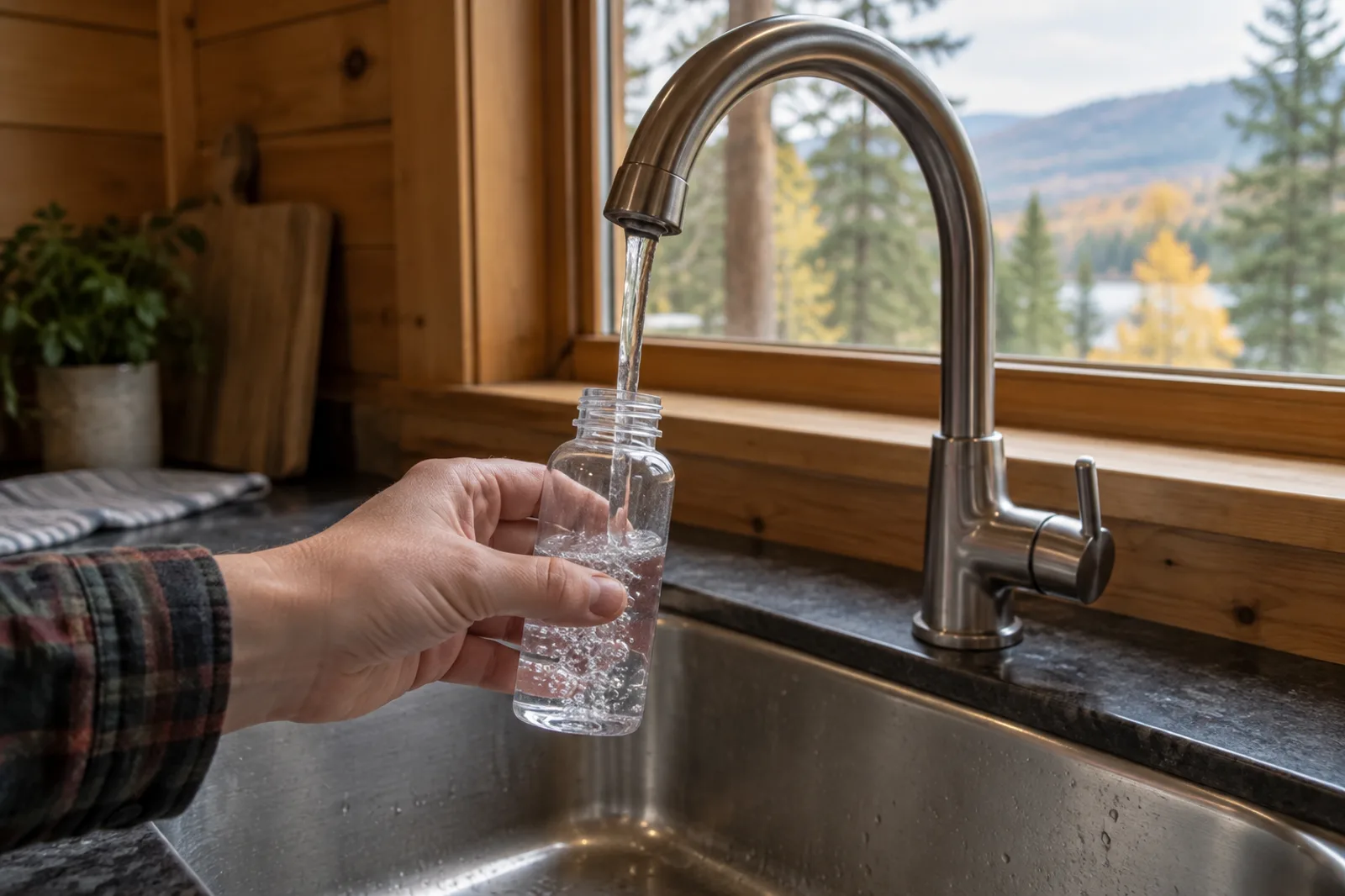
According to the Ministère’s page on the quality of well water, clear, odourless water can contain pathogens or nitrates/nitrites. It recommends an accredited laboratory:
- Twice a year, in spring and fall. For E. coli bacteria, enterococci and total coliforms.
- At least once while the well is in use. For physicochemical parameters, including arsenic, manganese, barium, nitrates/nitrites, iron and hardness.
Ask the seller for previous physicochemical analyses; if there are none, add them to the order, since arsenic and manganese cannot be seen in the glass.
Note the water source and septic system on each listing among the properties for sale in the Laurentians.
Casing and distances, two measurements to take during the visit
The technical guide summarizes section 17: the casing extends at least 30 centimetres above the ground, and the well must be 15 metres from a watertight system, such as a septic tank, and 30 metres from a non-watertight system, such as a leaching field. These distances also apply to the neighbours’ installations.
Take Saint-Hippolyte, where every residence is served by an individual wastewater treatment system (in French). On a lake with narrow lots, the neighbour’s leaching field may be less than 30 metres from the well you are interested in. Locate its lids and estimate the distance. For a well installed since 2015, the OACIQ mentions a hydrogeological report, required when the minimum distances are not met: ask the seller for it.
In this kind of area, the Ministère’s leaflet on well water (in French) advises also testing for nitrates and nitrites every spring and every fall. Finally, at the base of the casing, look for the mound that diverts runoff: its absence is among the causes of contamination.
Three dates pinpoint the age of a septic system
In short: August 12, 1981, July 20, 2000, and May 5, 2008, help date a septic system and its acquired rights.
The Ministère’s FAQ on isolated dwellings (in French) provides three benchmarks. The regulation dates from August 12, 1981: an older system may remain in use as long as it causes no nuisance or contamination, but it loses this acquired right after any work that would have required a permit. A seepage pit built since then is non-compliant.
A steel tank installed after July 20, 2000, is non-compliant unless a permit was issued earlier. Since May 5, 2008, prefabricated tanks have had an effluent filter at the outlet: without a filter, the tank is most likely older.
In Saint-Sauveur, the sale triggers an upgrade
Under By-law 560-2022, the Town of Saint-Sauveur (in French) requires, at the time of a transaction, that a seepage pit or a system predating August 12, 1981, be brought up to standard: the acquired right does not pass to the buyer with the cottage.
After 30 years, a system installed after 1981 requires a certificate of proper operation, renewed every eight years. A technologist or engineer who is a member of their professional order signs it after a fluorescein dye test and, for a conventional leaching field, exploratory holes and a smoke test, between May 1 and November 30. For an offer made in February, only the seller’s latest certificate counts.

One more bedroom than the plan, and the tank becomes too small
An added bedroom requires a permit, since the tank is sized according to the number of bedrooms. According to the Ministère’s FAQ, the system must then be brought up to standard, unless a professional shows that it can handle the additional flow.
Take a cottage advertised with four bedrooms, one of them finished in the basement without a permit, while the plan called for three. The Regulation respecting waste water disposal systems for isolated dwellings puts a number on the gap. Its section 15 sets the minimum tank capacity at 3.4 m³ for three bedrooms and 3.9 m³ for four, or 500 litres more.
The documents to ask the seller for
The OACIQ requires the seller’s broker to gather these documents:
- the drilling report and the initial water analysis for a well drilled since 2003, or the installation invoice for an older one;
- the municipal permit and the professional’s plan, which shows the planned number of bedrooms;
- the maintenance contract for a certified treatment system;
- the invoice for the last pump-out and a letter from the municipality about any notice of violation.
The pump-out schedule is covered in the guide to buying a lakefront house. The proof, however, varies by municipality. In Saint-Sauveur, it goes to the town planning department before September 30 of the year of the pump-out, otherwise the town may pump out the tank at the owner’s expense. In Piedmont (in French), it must be sent within 45 days. In Saint-Hippolyte, the municipality pumps out tanks itself and bills them on the tax account: ask for that tax bill.
Without any documents, the OACIQ calls for the listing to state “unknown system”: the inspection becomes the only source of information.
What the tests cost, and how long they take
As a benchmark, a 2025 municipal well-testing campaign (in French) in Saint-Basile, in Portneuf, advertised prices reduced by at least 40%, plus $45 for transport.
| Test | Who does it | Benchmark cost | Turnaround or season |
| Microbiological analysis | Accredited laboratory | $69.90 plus taxes (2025 campaign) | 1 to 4 weeks during the campaign |
| Microbiology, nitrates/nitrites and metals | Accredited laboratory | $186.30 plus taxes (2025 campaign) | 1 to 4 weeks during the campaign |
| Flow test | Well driller | On quotation, no published rate | Number of days set in the promise |
| Septic system certificate (Saint-Sauveur) | Technologist or engineer | At the owner’s expense | From May 1 to November 30 |
The turnaround matters more than the price: the campaign itself refers urgent needs to an accredited laboratory. The discount that Saint-Jérôme offers its residents in September (in French) is better suited to follow-up analyses.
Having the artesian well and septic tank inspected during the conditions period
A well or septic problem found during this period can be negotiated; discovered after the deed of sale, it has to be paid for.
The deadline for each condition is therefore based on the slowest test, and in winter, no certificate can be redone before May 1.
The seller cannot find the drilling report or the septic permit? A broker can help you set the number of days for each condition before the offer is drafted.
FAQ
What are the drawbacks of an artesian well?
They lie in what cannot be seen during the visit. Drawn from deep underground, water from an artesian well can naturally contain arsenic or manganese, which only a physicochemical laboratory analysis can detect. Its flow depends on the formation encountered during drilling and may fall short at peak hours. The owner must also maintain the well, or seal it if they stop using it.
What is the difference between a surface well and an artesian well?
Depth and construction. A surface well is generally made of stacked concrete pipes, often more than 600 millimetres in diameter, and rarely exceeds nine metres in depth. The artesian well, called a tubular well by the Ministère, is drilled when the water table is deep or the ground is rocky, with a steel casing more than six metres long. A surface well is more exposed to contaminants.
Who pays for the well and septic tank inspection when buying?
The buyer, as a general rule. Water quantity and quality tests, like the septic system inspection, are done at the buyer’s expense during the period set out in the promise to purchase. The seller may, however, agree to have the tank pumped out at their own expense before the deed of sale is signed and to provide written proof. Write this pump-out into the conditions rather than negotiating it verbally.